
PLANNING AT FOOD SCALE
Growing a lot is easy. Growing all year is the job.
A homestead garden can produce a lot of harvest. What's tricky is keeping that harvest going all season long and keeping a good record of what the ground actually gave you.
Anyone with ground can be buried in tomatoes in August. The hard part is keeping fresh harvests coming all season long. And that means having a succession plan that will carry you through.
Growing enough to can, freeze and store is a number, not a feeling. And without knowing what came in, from which bed, in which week, next year’s plan is just another educated guess.
Dozens of beds, hundreds of plantings and a season that never pauses. Keep all that in your head and you get the bed nobody replanted, and fall seedlings started three weeks late.
HOW HOMESTEADERS USE SEEDTIME
Two dates in, a year of harvest dates out
Type in your zip code and Seedtime pulls your average first and last frost and the length of your season. Every suggested seeding date is then scheduled from your frost dates, not from a seed packet’s national average.
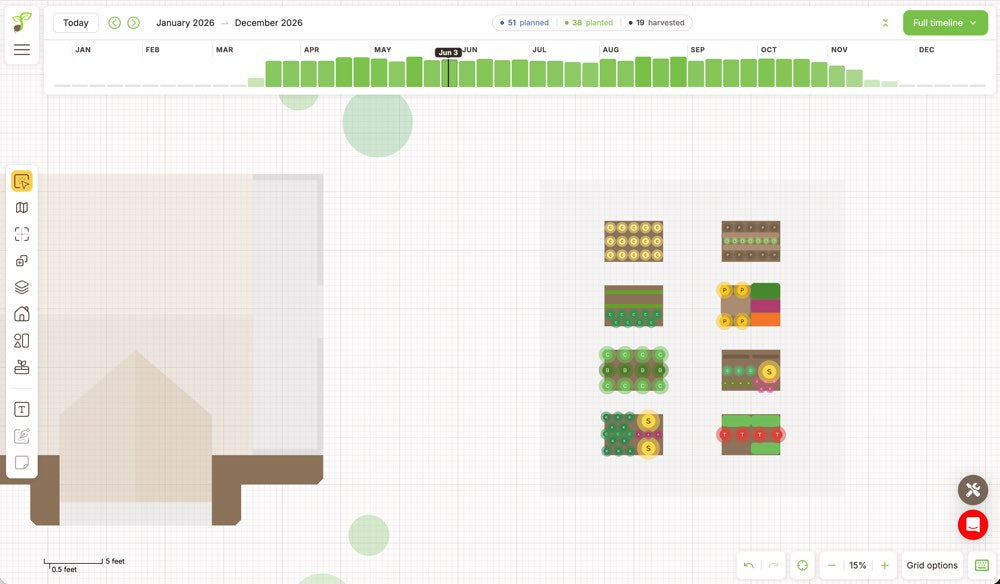
Draw every bed, row and container at its real size in the layout planner, with the house, the paths and the fence line where they actually sit. Seedtime helps you see what each one holds, so the seed order is a count rather than a hope.
One calendar covers the whole twelve, so the crops that have to be sown in July for a November harvest sit on the same timeline as the tomatoes you're picking. Overwintering greens, storage carrots and a spring cutting of kale get scheduled backwards from your first frost instead of getting lost in the shuffle of life.
Log harvests as you pick and Records & Analytics totals the pounds by crop, and by week, with a running value. Next winter’s plan starts from what your ground actually produced.
THE WHOLE PLACE, ONE PLAN
Every bed on one map, with the year on a slider
Draw the place as it really is, house, paths, fence line and all, then drag the timeline across the top and watch the map change underneath it: what's in the ground today, what has already been pulled, what's still to go in. Fifty plantings stop being a list and turn into something you can point at.
The free plan holds one layout with up to 8 rectangular beds, which is where most homesteads run out first. Basic and Unlimited lift the cap and open every bed shape.
THE HOMESTEAD TARGET
Something coming in every month, not just in August
The lean end of the year has to be planted furthest in advance. Which is exactly why it's the part that gets missed. One calendar covering all twelve months is how you stop missing it.
[[ seasonNote ]]
IN THEIR OWN WORDS
Growers who measure a season in pounds
“I have a large garden I manage myself in addition to a herd of goats and poultry that supplies our extended family year round... I can already see where the custom tasks can help plan my chick hatches and kiddings!”
“This site has helped me with its planning tools to grow a food garden that provided 1400 pounds of produce to the local food pantry last year! In prior years we have only reached 600 lbs.”
“As an experienced gardener with a large garden in a short Canadian growing season, Seedtime is making the efficient use and management of it so much easier than my out dated way of doing that through spreadsheets and document notes.”
“Seedtime has been an absolute instrumental tool in my family being self sufficient. They have given us the tools and confidence to grow our own food and keep a solid plan.”
WHAT IT COSTS
The free plan is a real plan. It just isn't a homestead plan.
The 8 bed cap goes first, probably in the first afternoon of drawing the place, along with non-rectangular bed shapes. Then unlimited custom crops, varieties and perennials, which come with Basic at $7 a month billed yearly. Seed and supply inventory and Records & Analytics harvest tracking are Unlimited, at $14 a month billed yearly, which also carries up to 20% off the Seedtime store (discount on both plans).
Compare plans“Both my husband and I agree it is a worthwhile investment for our new 3 year old little homestead. It makes it so I can see at a glance what we need to be working on this week, or any week of the year.”
Lisa · Nov 2023 · TrustpilotGOOD TO KNOW
Homestead planning questions, answered
The free plan holds one layout with up to 8 rectangular beds. Basic and Unlimited lift that cap and open every bed shape, so in-ground rows, round beds, hoop houses and containers can all sit on the same map as the raised beds. Planting schedules are unlimited on every plan, including free.
One calendar covers the whole twelve months, so a July sowing for a November harvest sits on the same timeline as the beds you're picking that week, and Seedtime counts the sowing date backwards from your first frost. Repeat sowings of the same crop each get their own dates, and planting schedules are unlimited on every plan, including free.
Records & Analytics logs harvests by crop, and by week, with weights and a running value, so the end of the season is a real number instead of a feeling. That, along with seed and supply inventory, comes with the Unlimited plan.
Unlimited custom crops and varieties, and unlimited perennials, come with Basic and Unlimited, so asparagus, rhubarb, berry rows and fruit trees live on the same calendar and the same task list as the annual beds rather than in a separate notebook. Perennial crops are added as custom crops right now.
Containers, balconies and GreenStalks, with successions that keep a small space producing.
See how Backyard gardenersBeds you already have, sown in waves so the harvest lands across the season instead of all at once.
See how Market farmersSequence plantings and harvest windows so the farm stand never sits empty all season.
See howPlan next year before the seed catalogs land
Create your free account, draw the beds you already have, and let Seedtime turn two frost dates into a year of sowing, harvest and pull dates.
Plan My Homestead FreeFree forever · No credit card required
Seedtime is the free online garden planner for real gardens - a personalized planting calendar, a garden layout planner with square foot gardening built in, and AI planning tools for vegetable gardens, flower gardens, raised beds, and vertical planters.